The Essential Language of Digital Interaction: A Deep Dive into Computer and Hardware Icons
In our visually saturated digital landscape, communication often transcends text. We rely on symbols, shapes, and simplified graphics to convey complex ideas instantly. Among this visual lexicon, computer and hardware icons stand as a fundamental dialect. They are the universal signs for the physical and logical components that power our technology, serving as critical navigational aids and explanatory tools across countless interfaces.
What Constitutes the Computer and Hardware Icon Set?
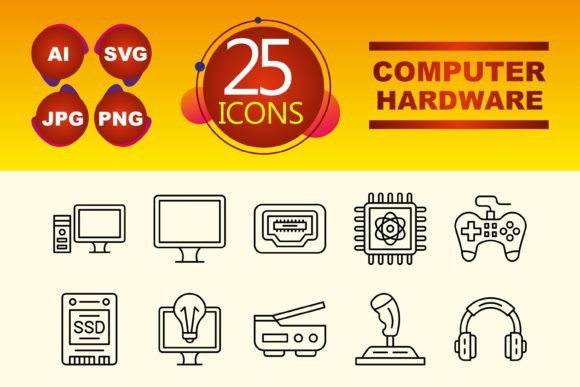
When we discuss a set dedicated to computer and hardware, we refer to a curated collection of visual representations of key technological components. This isn't merely about drawing a generic laptop or a mouse. It involves distilling the essence of specific, recognizable items into their most minimal, communicative form. A typical set, such as one offering ten icons in a line style, would cover core elements. Think of icons for a central processing unit (CPU), a memory module (RAM), a hard drive or solid-state drive, a motherboard, a graphics card, a power supply, a computer case, a cooling fan, a network router, and perhaps an input device like a keyboard. Each icon acts as a visual shorthand for that component, bypassing lengthy descriptions.
The Significance of the Line Icon Style
The choice of line icon style is particularly noteworthy for this subject matter. Line icons are defined by their use of clean, unbroken strokes to create outlines and details without filled colors or complex shading. This style offers distinct advantages for representing computer hardware. First, it conveys precision and technical clarity, mirroring the engineered nature of the actual components. The crisp lines can effectively depict circuit traces on a motherboard, the fins on a heatsink, or the slots on a memory stick. Second, the minimalist nature ensures scalability and versatility. A line icon can be rendered at a tiny size for a mobile app toolbar or enlarged dramatically for a presentation slide without losing its recognizability or becoming visually overwhelming.
The Multifaceted Applications of Hardware Icons
The utility of these icons extends far beyond a single platform or medium. Their design intent—to be clear, scalable, and universally understood—makes them cross-functional assets.
- Mobile Applications: In tech utility apps, system monitors, or e-commerce platforms selling components, these icons are used for navigation, status indicators, and product categorization. A user might tap a hard drive icon to access storage management settings.
- Website Templates: For tech blogs, hardware review sites, IT service company pages, or online computer part stores, these icons serve as visual anchors. They can break up text-heavy content, illustrate feature lists for different products, or act as intuitive menu items for site sections dedicated to specific hardware topics.
- Presentations & Infographics: Educators explaining computer architecture, business professionals outlining IT infrastructure, or creators making tech explainer videos rely on these icons. They transform complex technical diagrams into accessible, easy-to-follow visual stories, highlighting the relationship between components in a system.
- User Interface Design Templates: For UI/UX designers prototyping software for system diagnostics, configuration tools, or build-your-own-PC applications, a ready-made set of hardware icons is a foundational kit. It allows for rapid, consistent visualization of functions without requiring custom illustration from scratch.
File Format Considerations: AI, JPG, PNG, SVG
The inclusion of multiple file types—AI, JPG, PNG, and SVG—is a crucial feature that speaks to professional utility. The Adobe Illustrator (AI) file is the editable source, allowing designers to modify colors, stroke weights, or even adapt the icons for bespoke projects. JPG and PNG are raster formats suitable for fixed-size use in web pages or documents where further scaling isn't required. PNG, with its support for transparency, is especially valuable for overlaying icons on varied backgrounds. The SVG (Scalable Vector Graphics) format is perhaps the most important for modern digital use. As a vector format, it ensures the icons remain perfectly sharp at any resolution, making them ideal for responsive websites and applications that adapt to different screen sizes. This multi-format offering ensures the icons are truly ready for any implementation scenario a creator might encounter.
Why This Visual Language Matters for a Broad Audience
The relevance of computer and hardware icons spans the entire spectrum of users, from the casual consumer to the seasoned professional.
For professionals like IT administrators, network engineers, or hardware developers, these icons are tools for creating clear documentation, system diagrams, and internal training materials. They facilitate precise communication about technical setups without ambiguity.
Consumers and hobbyists building or upgrading their own computers benefit from icons in buyer's guides, tutorial videos, and configuration software. A visual guide showing where a graphics card icon plugs into a motherboard icon can be more instructive than paragraphs of text.
Educators and researchers use these icons to demystify technology for students and to illustrate concepts in academic papers or presentations, bridging the gap between abstract theory and tangible components.
Business owners marketing tech services or products use them to create cleaner, more engaging marketing materials, infographics about their IT offerings, or intuitive interfaces for client portals.
Creators—UI designers, graphic artists, and content developers—integrate these icons into their work to enhance usability and aesthetic coherence in projects related to technology. They provide a layer of immediate semantic understanding.
Characteristics for Effective Implementation
To leverage these icons effectively, certain principles should be observed. Consistency is paramount; using icons from the same stylistic family throughout a project maintains visual harmony and user confidence. Context is key: an icon for a CPU is powerful when placed next to performance metrics, but might confuse if used arbitrarily. Furthermore, while the icons are symbolic, they should be paired with supporting text or labels where necessary for absolute clarity, especially for less technical audiences. The goal is not to replace language entirely, but to augment and accelerate comprehension.
Ultimately, a well-designed set of computer and hardware icons does more than decorate a screen. It builds a bridge. It translates the intricate, often physical world of chips, boards, drives, and connectors into a streamlined visual language that can be understood across cultures, skill levels, and platforms. By providing this set in a versatile line style and across all critical file formats, it empowers a vast range of individuals and organizations to communicate, educate, design, and operate more effectively in our digitally driven world. They become not just graphics, but essential components of our shared interface with technology itself.